TL;DR: Environmental risks are often invisible, but monitoring makes them measurable and manageable. Having the right detection systems in place protects workers, ensures compliance, and prevents costly downtime.
Key Takeaways:
- Hidden hazards like gases, dusts, and temperature shifts can cause major risks without warning.
- Monitoring provides real data that replaces assumptions and supports compliance.
- Proper placement, calibration, and training are essential for reliable systems.
- Investing in monitoring saves costs by preventing accidents, downtime, and regulatory penalties.
What Environmental Monitoring Really Means
Environmental monitoring is the continuous process of tracking workplace conditions that influence safety, compliance, and operational stability.
It ensures that risks, often invisible to the human eye, are identified before they turn into costly incidents.
By making unseen hazards measurable, monitoring equips companies with the data to act quickly, prevent accidents, and maintain business continuity.
It transforms potential threats into actionable insights that protect both people and operations.
The Big Parameters
- Gases and vapours: Monitored for flammability, toxicity, and oxygen displacement. Oxygen percentage is tracked to prevent hypoxia or enriched oxygen fires.
- Dusts and aerosols: Checked for respiratory harm and cleanroom integrity.
- Temperature and humidity: Monitored to safeguard people, processes, and equipment.

Signals That Predict Trouble
- Volatile organic compounds: Often signal leaks or sudden process changes. They act as an early warning that something is off.
- Noise levels: Show when workers face hearing risks and when alarms may be drowned out by background sound.
- Vibration patterns: Indicate mechanical wear, loose fittings, or structural strain that could lead to failure if ignored.
- Odours: Even faint smells can reveal process issues or hazards building up that need prompt attention.
Why Monitoring Beats Assumptions
Assumptions collapse under changing conditions. Real time data does not.
Carbon monoxide is odourless, making it undetectable without proper instruments.
Flammable gas clouds also remain invisible until they ignite, which makes them particularly dangerous without monitoring in place.
Workplace conditions can shift quickly, especially during maintenance or shutdowns.
In these moments, data and alarms provide facts that replace guesswork and give teams the confidence to make safe, informed decisions.
Regulations That Make It Non Negotiable
Singapore’s Workplace Safety and Health rules require risks to be identified, tested, and controlled.
For confined space entry, certified gas testing and continuous monitoring are mandatory.
The Fire Code demands approved detectors for hazardous sites and LPG use, while ISO 45001 emphasises systematic monitoring and ongoing improvement.
Together, they show that reliable data is not just good practice but a core compliance requirement.
Four Steps From Hazard To Insight
1. Identify The Hazards
Start by mapping out flammable, toxic, and oxygen related risks in each work area and for every task. This step helps reveal where hazards may build up and who might be affected.
Also consider how conditions shift during start up, shutdown, or maintenance. These are the moments when processes are less stable, and monitoring becomes even more critical to protect workers and operations.
2. Select Fit For Purpose Sensors
Choose sensor technology that matches the specific hazards present and the conditions of the site. Make sure the equipment is certified for use in hazardous zones and built to withstand factors like heat, humidity, or rain.
3. Integrate And Make Alarms Actionable
Connect both fixed and portable monitors to systems such as SCADA, DCS, or cloud platforms so that all data is visible in one place. This makes it easier to spot problems quickly and coordinate a fast response.
When setting alarm thresholds, define clear responsibilities and actions for each level of alert. This ensures that alarms trigger not just noise, but immediate and effective steps from the right people.
4. Maintain And Prove Reliability
Plan regular bump tests, calibrations, and inspections so the equipment is always reliable. These checks keep sensors accurate and ready when they matter most.
Keep certificates, logs, and service records organised and accessible. Having proper documentation not only satisfies auditors but also proves that the system is well maintained.
Common Mistakes That Break Systems
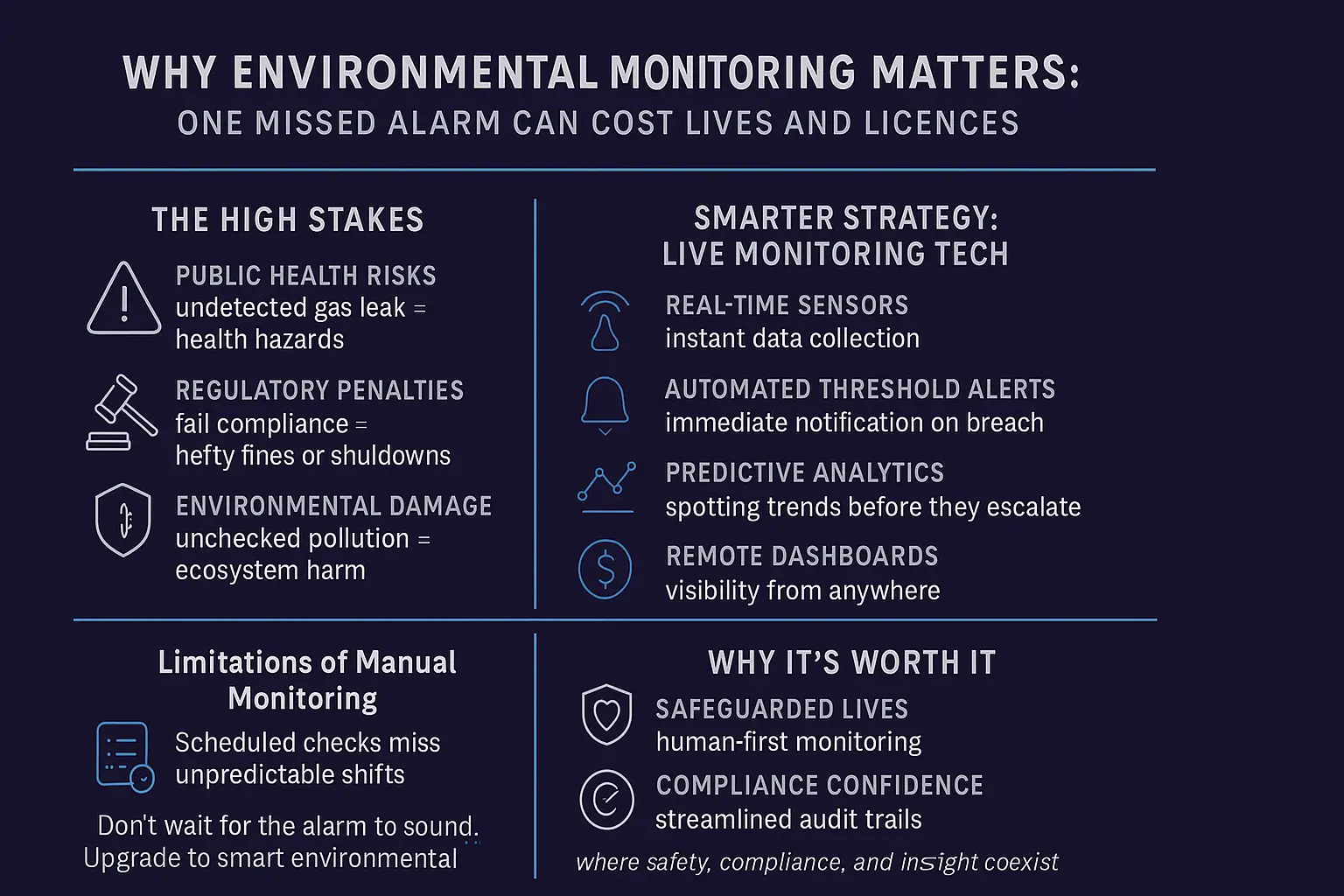
Treating monitors as simple checkboxes often leads to blind spots, where hazards slip through unnoticed.
Choosing cheap or unsuitable devices may seem like savings at first, but it usually ends up costing more in failures, downtime, and added risk.
Too many false alarms can quickly create alarm fatigue, making people less likely to respond when it really counts.
Poor placement of detectors leaves hidden gaps near floors, ceilings, or corners, while ignoring calibration drift eventually turns sensors into silent failures.
For more insights into how monitoring links directly to compliance, explore our resource on why environmental monitoring is essential for safety and compliance.
Where Monitoring Pays Off Fast
Confined Spaces
Conditions inside confined spaces can shift quickly without warning. Always test the atmosphere before entry, and keep monitoring active during the entire task.
This ongoing check ensures that workers are protected from sudden changes, giving them a safer environment and time to respond if danger appears.
Utilities And Energy
Boilers, generators, and battery rooms often carry hidden risks of gas leaks and potential fires.
By using detectors and automatic interlocks, companies can catch issues before they escalate, shutting down equipment or activating ventilation systems to keep both people and assets safe.
Manufacturing And Warehousing
Solvents, LPG forklifts, and charging stations bring everyday risks that can easily be overlooked.
Each has the potential to release dangerous fumes or create ignition sources if not properly managed.
By using reliable leak detection systems, companies can protect staff from exposure and safeguard valuable inventory and facilities from costly damage.
Data Centres And Labs
Cooling systems, stored fuel, and compressed gas cylinders all demand close attention because even small leaks or malfunctions can create major hazards.
These areas often operate quietly in the background, but any failure can have serious consequences.
Selecting The Right Instruments
Fixed Or Portable
Fixed systems are designed to continuously watch over areas where known hazards exist, such as production lines or utility rooms.
Portable devices, on the other hand, give protection to mobile workers and maintenance crews who move between different zones and need flexibility.
Single Gas Or Multi Gas
Single gas sensors are highly effective when the risk is specific and well defined.
Multi gas devices are better for broader coverage, especially during maintenance or confined space entry, when several unknowns may be present.
Point, Line, Or Open Path
Point detectors work best near valves, flanges, or other precise leak points.
Line and open path systems are ideal for monitoring larger spaces, such as warehouses or storage yards, where wide area coverage is critical.
For more context on how monitoring prevents risks in different workplaces, see our guide on how environmental monitoring prevents workplace hazards.
Why Choose Minerva
We provide more than just products. Our team delivers tailored solutions backed by deep application knowledge and continuous support to keep your systems reliable over time.
We align every design with Singapore’s strict codes and standards, helping you meet Fire Code and MOM requirements with confidence.
By partnering with leading global brands and innovators, we ensure proven reliability with solutions adapted to local conditions.
For a deeper look at how we support gas, flame, and environmental monitoring, explore our detection and monitoring solutions.
Take Action Now
Stop relying on guesswork when it comes to safety.
With the right system in place, you can protect your people, secure compliance, and keep your business running without costly interruptions.